How to Photograph Manchester at Night: A Complete Guide for Stunning Cityscape Photography
How to Photograph Manchester at Night: A Complete Guide to Manchester Night Photography
Manchester is a fantastic city to photograph after dark. The combination of historic architecture, modern skyscrapers, illuminated streets, reflections, canals and the movement of Manchester’s trams creates endless opportunities for atmospheric cityscape photography.
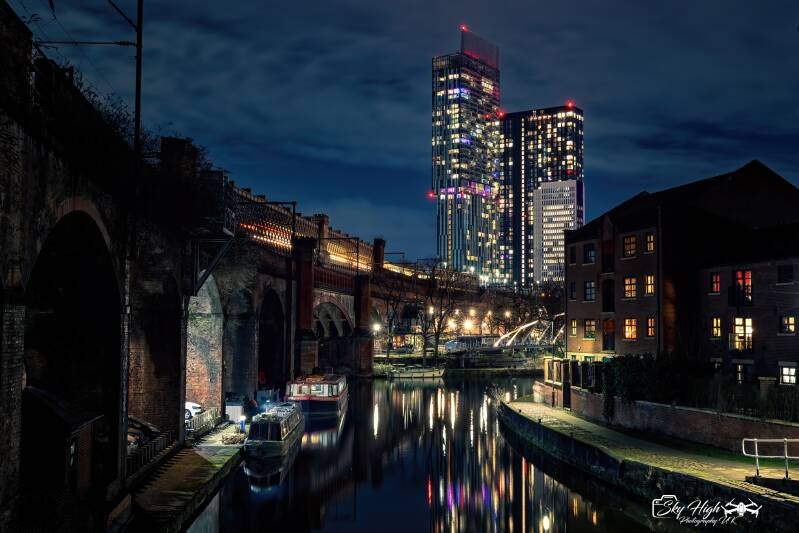
As a Manchester photographer, I spend a lot of time photographing the city at night, particularly around locations such as Castlefield, St Peter’s Square and Manchester city centre. Night photography can completely change the way familiar locations look, and with the right camera settings and approach, you can create images with much more atmosphere and impact.
In this guide, I’ll share some of the techniques I use when photographing Manchester after dark, including choosing locations, camera settings, long exposures, light trails and working with the city’s artificial light.
The Best Locations for Manchester Night Photography
One of the great things about photographing Manchester at night is the variety of locations available within a relatively small area.
Castlefield
Castlefield is one of my favourite areas for Manchester night photography.
The canals, bridges, historic buildings and modern city skyline give you plenty of opportunities to combine architecture with reflections and light.
The canals can work particularly well after dark because the water can create reflections from the surrounding buildings and lights. Look for compositions that include leading lines from the canal or towpath, and don’t be afraid to experiment with longer exposures.
Castlefield is also a great location for photographing the Manchester skyline, especially when the city lights begin to come on.
St Peter’s Square
St Peter’s Square provides a very different type of cityscape.
The combination of Manchester Central Library, the Midland Hotel, the Town Hall area and the surrounding city lights creates opportunities for both wide-angle compositions and more detailed architectural photographs.
It’s also an excellent location for experimenting with different perspectives and incorporating people, trams and movement into your photographs.
Manchester City Centre
Manchester city centre offers endless opportunities once you start looking beyond the obvious viewpoints.
Modern buildings, illuminated streets, reflections in wet pavements and moving traffic can all become part of the photograph.
Look for contrasts between Manchester’s historic architecture and its modern skyline. These combinations can make particularly strong cityscape images.
Manchester Trams and Light Trails
Manchester’s trams can add movement and colour to a night photograph.
With a longer exposure, a moving tram or vehicle can create light trails through the frame, adding another element of movement to an otherwise static cityscape.
The key is to experiment with your position and timing. Rather than simply photographing the tram itself, try incorporating it into a wider composition that includes the surrounding architecture.
When Is the Best Time to Photograph Manchester at Night?
You don’t necessarily need to wait until it is completely dark.
One of my favourite times to photograph the city is around blue hour, when there is still some colour and detail in the sky but the city lights have started to come on.
This can give you a much more balanced exposure between the sky and the buildings.
As the evening gets darker, you can then concentrate more on artificial light, reflections, light trails and longer exposures.
Cloud can also make a big difference. A completely clear sky can work well, but broken or textured cloud can add considerably more interest to a cityscape.
Rain can also be useful for photography. Wet pavements and surfaces can create reflections from street lights, shop fronts and buildings, adding colour and depth to the scene.
Camera Settings for Manchester Night Photography
There isn’t one perfect set of camera settings for night photography. Your settings will depend on the available light, the effect you’re trying to create and whether you’re photographing from a tripod.
However, these are good starting points.
Aperture
For most cityscape photographs, I often work somewhere around f/8 to f/11 when I want good depth of field and detail throughout the scene.
Stopping down can also produce attractive starbursts around bright lights.
Shutter Speed
This is where night photography becomes particularly interesting.
A shutter speed of several seconds can smooth reflections, capture movement and create light trails from traffic.
If you’re photographing moving subjects such as trams or cars, experiment with different shutter speeds rather than simply relying on one setting.
ISO
When your camera is securely mounted on a tripod, keep your ISO as low as practical.
A lower ISO can help produce cleaner files with less noise, particularly when you’re making larger prints or carrying out significant editing.
Focus
Autofocus can struggle in very dark conditions, particularly when there isn’t much contrast for the camera to lock onto.
Once you’ve established focus, consider switching to manual focus so that the camera doesn’t refocus between exposures.
Shoot in RAW
If your camera allows it, shoot in RAW.
Night scenes often contain a wide range of tones, from very bright lights to extremely dark areas. RAW files give you considerably more flexibility when recovering shadows, controlling highlights and adjusting colour during editing.
How to Capture Light Trails in Manchester
Light trails are one of the easiest ways to introduce movement into a cityscape.
Look for roads, junctions or tram routes where you can safely photograph passing traffic.
A tripod is essential for this type of photography because you’ll normally be using a relatively slow shutter speed.
Start with a few seconds and adjust from there. If the trails aren’t long enough, increase the shutter speed. If they’re becoming too dominant or the highlights are becoming overexposed, shorten the exposure.
The exact settings will change depending on the location and available light, so experimentation is part of the process.
Long Exposure Photography in Manchester
Long exposure photography can completely change the appearance of a familiar Manchester location.
It can smooth water, create movement in clouds, produce light trails and turn passing traffic into streaks of colour.
A sturdy tripod is important, particularly when you’re working with exposures lasting several seconds or longer.
I also recommend using a remote shutter release or your camera’s self-timer to minimise camera movement when taking the photograph.
Take your time with composition. A long exposure won’t rescue a weak composition, so spend time deciding what you want the viewer to look at before pressing the shutter.
My Published Castlefield Night Photograph
One of my own Manchester night photographs, taken in Castlefield, was featured in a Digital Camera Magazine cityscape photography tutorial.
The tutorial looks at the techniques and creative decisions behind the photograph, including working with Manchester’s city lights, composition, reflections and exposure.
It’s a good example of the type of practical night photography I enjoy — taking a familiar Manchester location and looking for ways to use light, movement and long exposure to create something more atmospheric.
You can read my Digital Camera Magazine cityscape photography tutorial and see the published photograph for yourself.
Common Manchester Night Photography Mistakes
Using too much ISO
It can be tempting to increase ISO immediately when the light disappears. If you’re using a tripod, however, you can often keep the ISO lower and allow the shutter speed to do more of the work.
Forgetting about the sky
Don’t concentrate entirely on the buildings.
The sky can make a huge difference to a cityscape, particularly around blue hour or when there is interesting cloud.
Rushing the composition
Night photography often rewards patience.
Walk around the location and look for different viewpoints before settling on a composition. A few metres in either direction can completely change the relationship between buildings, lights and reflections.
Overexposing city lights
Bright signs, street lights and illuminated buildings can easily become overexposed.
Keep an eye on your highlights and use your histogram if necessary. It’s usually easier to work with a slightly darker exposure than to recover completely blown highlights.
Ignoring reflections
After rain, Manchester’s streets and canals can become fantastic photographic opportunities.
Look for reflections in puddles, wet pavements and water around the canals. Sometimes the reflection can become just as important as the subject itself.
My Tips for Better Manchester Night Photography
If you’re starting out with night photography in Manchester, my biggest advice is to slow down.
Don’t feel that you need to photograph everything you see.
Choose one location and spend some time exploring it. Try different compositions, focal lengths and shutter speeds.
Look for:
- Leading lines
- Reflections
- Light trails
- Interesting skies
- Contrasts between old and new architecture
- Moving subjects
- Interesting foregrounds
- Symmetry and repeating patterns
And most importantly, don’t be afraid to experiment.
Some of the best cityscape photographs can come from simply trying a composition or camera setting that you wouldn’t normally use.
Learn Manchester Night Photography With Me
If you’d like to improve your night photography skills and learn how to photograph Manchester after dark, I also run Manchester Night Photography Workshops.
The workshops are practical and hands-on, taking place at some of Manchester’s best photography locations.
You’ll learn how to work with your camera in low light, understand long exposure photography, create light trails and make the most of Manchester’s city lights, architecture and reflections.
The workshops are suitable for beginners and photographers looking to develop their existing skills, with small group workshops and private 1-to-1 tuition available.
You can find out more about my Manchester Night Photography Workshop and see what’s included.
Frequently Asked Questions About Manchester Night Photography
What camera settings should I use for Manchester night photography?
There isn’t one fixed setting that works for every situation. As a starting point, try a low ISO, an aperture around f/8 to f/11 and a shutter speed of several seconds when using a tripod. Adjust your settings according to the available light and the effect you’re trying to achieve.
Do I need a tripod for Manchester night photography?
A tripod is highly recommended for long exposures and light trails. It allows you to use slower shutter speeds while keeping the camera stable.
Where is the best place for night photography in Manchester?
Castlefield is one of my favourite locations because of its canals, reflections, historic architecture and views towards the Manchester skyline. St Peter’s Square and Manchester city centre also offer plenty of opportunities.
Can I photograph Manchester trams at night?
Yes. Manchester’s trams can make excellent subjects for night photography, particularly when combined with longer exposures and surrounding city architecture.
Is Manchester night photography suitable for beginners?
Absolutely. You don’t need to be an expert to start experimenting with night photography. Understanding the basics of aperture, shutter speed and ISO will give you a good foundation, and practical experience is one of the best ways to improve.
Do you offer Manchester night photography lessons?
Yes. I offer both small group Manchester Night Photography Workshops and private 1-to-1 photography tuition, giving you the opportunity to learn in a practical, hands-on environment.
Final Thoughts
Manchester looks completely different after dark.
From the reflections and canals of Castlefield to illuminated architecture, moving trams and city light trails, there are countless opportunities to create interesting photographs.
The key is to take your time, experiment with your settings and pay attention to the light around you.
Once you understand how to control shutter speed, aperture and ISO, you can start moving beyond simply recording what you see and begin creating more intentional night photographs.
If you’d like to learn these techniques in person, take a look at my Manchester Night Photography Workshop and join me for a practical evening photographing the city after dark.